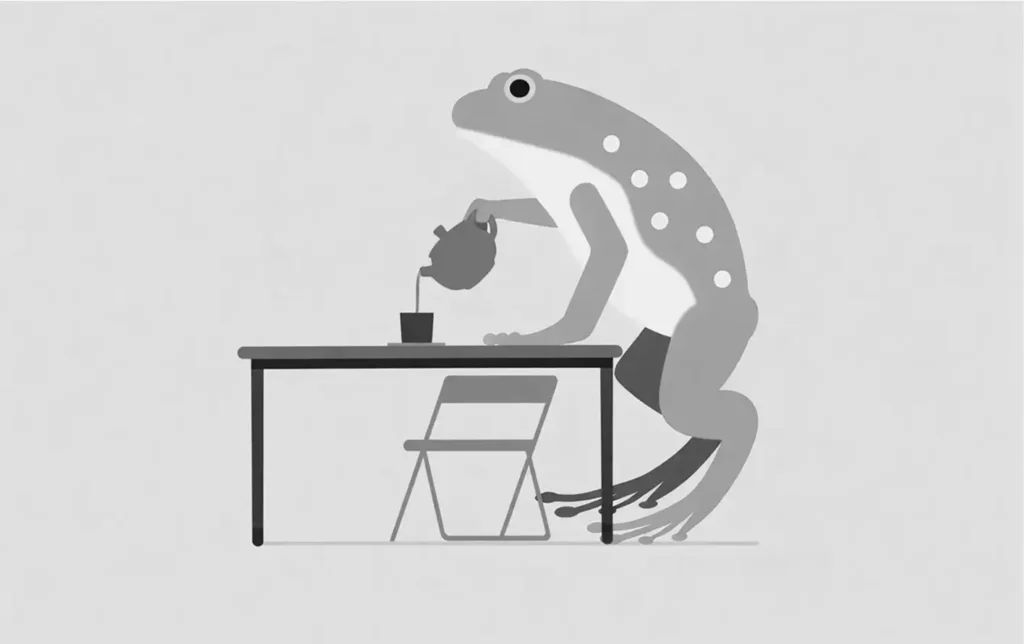
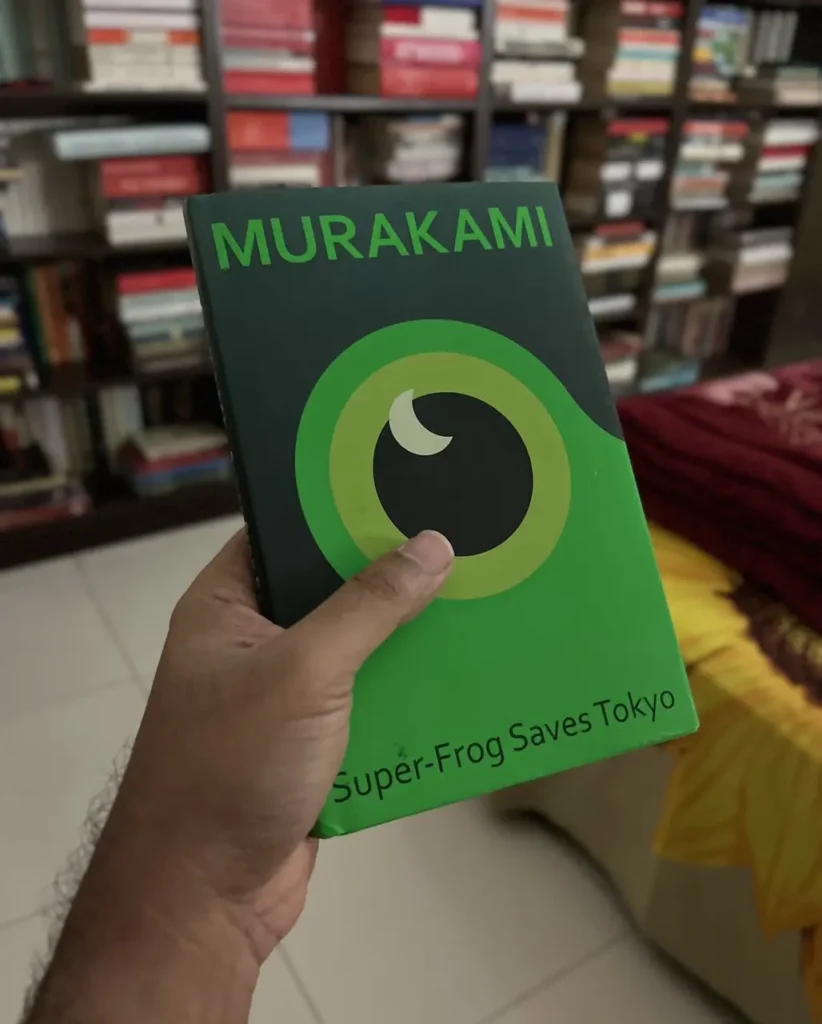
I read the illustrated edition designed by Suzanne Dean and Seb Agresti, published by Penguin Random House, and the visual language they bring to Murakami’s already strange world makes the strangeness feel even more precise.
Spoilers Ahead!
The story itself is deceptively simple. A giant frog walks into a bank employee’s apartment, tells him an underground worm is about to cause a catastrophic earthquake beneath Tokyo, asks for his help, fights the worm, dissolves into maggots, and disappears. Katagiri, the bank employee, is shot by gangsters somewhere in the middle of it, wakes up in a hospital, and never fully understands what happened. Tokyo is saved. Nobody knows. Life continues. If you were to describe this plot to someone who hadn’t read it, they would assume it was absurdist comedy or children’s fantasy. It is neither.
What Murakami is doing here, what he almost always does, is using the surreal as a delivery mechanism for things realism can’t quite hold. The frog is real in the story the same way dreams feel real while you’re having them. You don’t question it from inside the experience.
This is the Kafkaesque quality critics often point to in Murakami’s work, not Kafka’s paranoia exactly, more that same suspension of the rules of the real without any announcement that the rules have been suspended. Gregor Samsa wakes up as a bug. Nobody remarks on how that’s impossible. Frog walks into Katagiri’s apartment. They seat and drink tea. The matter-of-factness is the whole point.
The story isn’t all about a frog and a bank employee rescuing Tokyo from an earthquake that’ll be caused by a giant worm, though. It’s about what’s hidden beneath in our society. The Worm, and Murakami capitalizes it, which matters, feeds on accumulated anger, humiliation, and despair. It lives beneath the city, growing heavier on everything society refuses to process out loud.
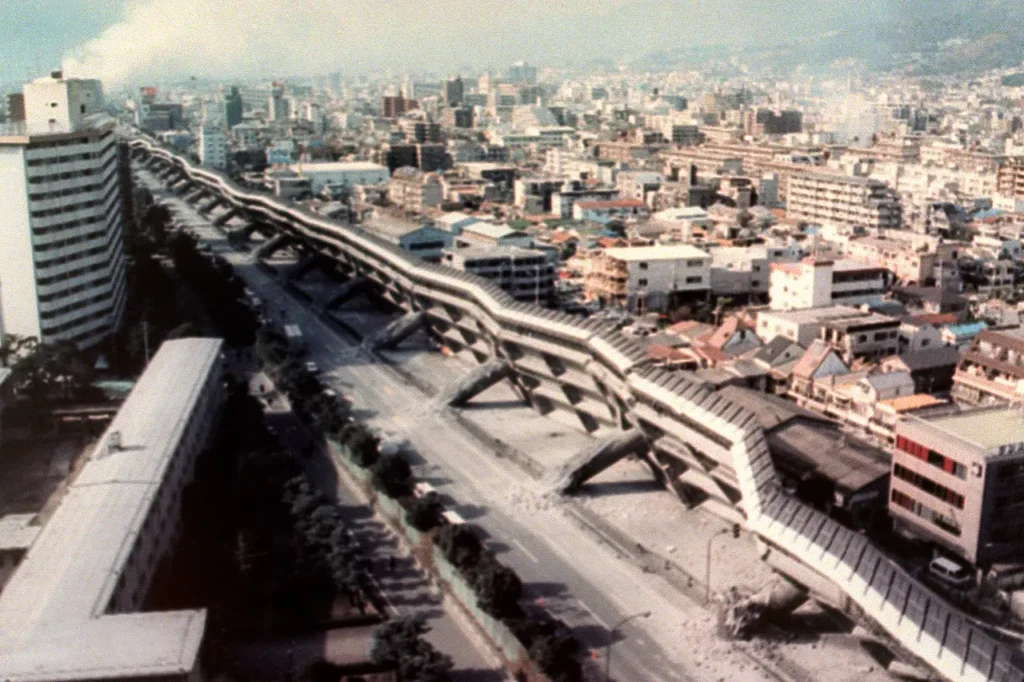
To understand why Murakami built this image, you have to understand the timeframe of the publication of this story. This was first published in 2000 in his short story collection After the Quake. The collection was written in response to the psychological aftermath of the 1995 Kobe earthquake, and Murakami explores its emotional and social impact through surreal stories rather than direct realism.
Japan in the early 1990s, and specifically the climate that preceded January 17, 1995, when the Great Hanshin Earthquake aka Kobe Earthquake killed more than 6,000 people in and around Kobe.
The 1980s in Japan had been extraordinary. The economy ballooned into something almost mythic. Land prices in Tokyo were, at their peak, absurdly inflated, the stock market was euphoric, and Japan’s ascendancy as a global economic power seemed permanent. Companies offered lifetime employment. Social structures were rigid but felt stable because prosperity gave them cover. Then the bubble burst in 1991.
The next decade became what economists and historians would name the Lost Decade, and the name is accurate in ways beyond the financial. Property values collapsed. Banks failed. Jobs disappeared. The social contract that had asked Japanese people to suppress individuality, to work without complaint, to defer personal expression in exchange for security, that contract suddenly had nothing to offer in return. The anger that had always been accumulating beneath the surface of a society that culturally discourages open confrontation had nowhere to go. It went underground. It became the Worm.
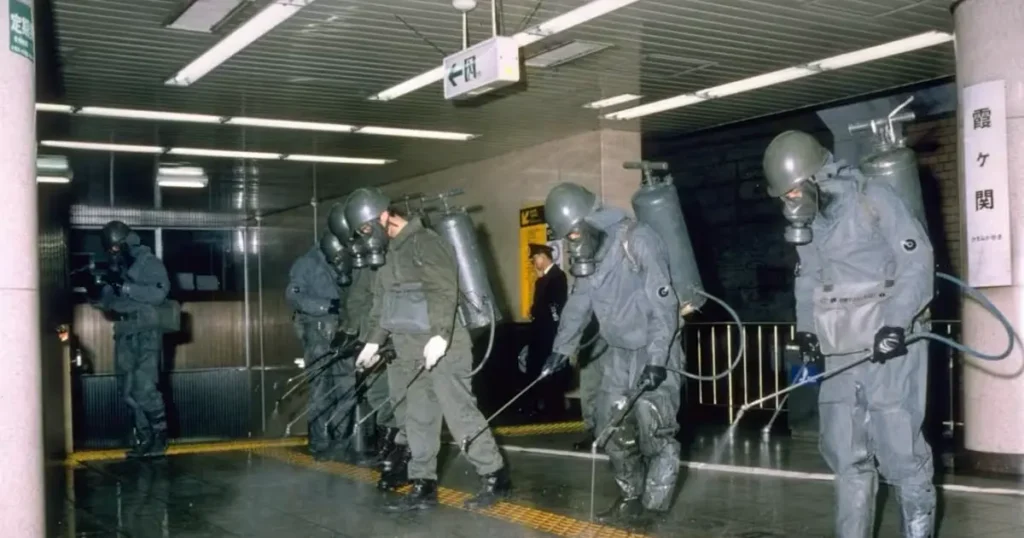
Two months after the Kobe earthquake, Aum Shinrikyo released sarin gas into the Tokyo subway system during morning rush hour. The attackers were educated, middle-class, seemingly ordinary people. They had been radicalized quietly, in secret, by ideological frustrations that ordinary society had no framework to absorb. Murakami was so disturbed by this that he spent years interviewing survivors and perpetrators, which became the nonfiction work Underground. What frightened him was the hiddenness of it. The way it grew in the dark, unremarkable from the outside until it wasn’t. That’s the Worm. That’s exactly the Worm.
The Jungian reading is hard to avoid and I think it’s genuinely correct here. If Worm is the collective Shadow, the repository of everything a culture represses and refuses to acknowledge, then Frog is something closer to the moral imagination. Not the ego, not the heroic self, more that capacity for confronting darkness that most people don’t know they have until something forces it.
Frog doesn’t choose a soldier or a politician or someone with obvious power to stand beside him. He chooses Katagiri, who is unattractive and poor and lonely and almost entirely unnoticed by the world. Katagiri has spent his life quietly doing the decent thing, helping clients who can’t repay, working honestly, supporting his siblings, receiving nothing for it. Frog says without him the battle cannot be won. And then Katagiri never actually fights. His role is belief. His role is showing up.
This is where Murakami becomes genuinely moving rather than merely clever. There’s a long tradition in literature of the hidden sustainer, the person whose invisible labor holds structures together while receiving no recognition. Dostoevsky understood this, which is probably why some critics see echoes of his meek characters in Katagiri.
Mishima‘s work circles around the question from the opposite direction, obsessed with visibility and heroism and the cost of both. Murakami insists that the world survives because of people nobody celebrates. This is presented as a structural fact about how civilization actually works, which makes the ending feel less like tragedy and more like plain truth. Tokyo is safe. Katagiri returns to his ordinary life. Nobody asks why.
The frog dissolving into maggots is the image that stays with you. Murakami uses grotesque imagery with unusual care. It’s never gratuitous, always earned. The dissolution suggests that heroism cannot sustain itself in the visible world, that confronting darkness costs something, that the surreal cannot be domesticated into anything comfortable. It also suggests that Katagiri’s mind, if this has all been psychological, is reaching the limits of what it can hold. The story refuses to adjudicate between these readings. The ambiguity is not laziness. It’s the point. Reality, for Murakami, is always unstable at the edges. Dreams shape waking life. The subconscious is a battlefield, and the battles there are as consequential as any other kind.
The illustrations by Suzanne Dean and Seb Agresti understand all of this. There’s a restraint to the visual choices that mirrors the story’s own restraint, the scale of Frog against domestic space, the way light and shadow are used around the Worm, the smallness of Katagiri in his environment. It moved our team at Fluent Support to put something together of our own: an ebook designed by Abir, with design suggestions I helped think through, written and developed through interviews by Sadman, and reviewed by our full team.
What I keep returning to is Murakami’s basic insistence that the earthquake is not only geological. The ground cracks when the suppression becomes too heavy. That’s not mysticism. That’s sociology rendered into myth, and the myth is only possible because the history underneath it is real.
Mark Twain supposedly said, “History doesn’t repeat itself, but it often rhymes”. Reading Murakami in 2026 feels like hearing a familiar melody from somewhere you can’t quite place. The Worm doesn’t always need a specific geography. Look at what’s happening right now. Millions of people who spent years building skills, developing taste, learning craft, feeding their knowledge into systems and portfolios and careers, are watching a machine consume all of it and reproduce them at near-far less costs.
The thing they were told made them valuable is being automated away, quietly, efficiently, without ceremony. The anger that produces isn’t loud yet. It’s accumulating. It’s going underground. Meanwhile, the markets are stretched thin over a global economy already shaking from active wars, supply fractures, and the particular kind of institutional distrust that grows when people feel the system was never really built for them.
The 1980s Japanese bubble felt permanent, too, right until it didn’t. There’s a version of this story where the Worm wakes again, fed by a different century’s worth of humiliation and displacement, and nobody has sent a frog ahead to warn us.
What Murakami understood about 1995 Japan is that the disaster announced itself slowly, in the silence of people who stopped believing their lives were going to be alright. That silence is not hard to find today. The question worth sitting with isn’t whether the pressure is building. It’s whether anyone is paying attention to what’s underneath.