

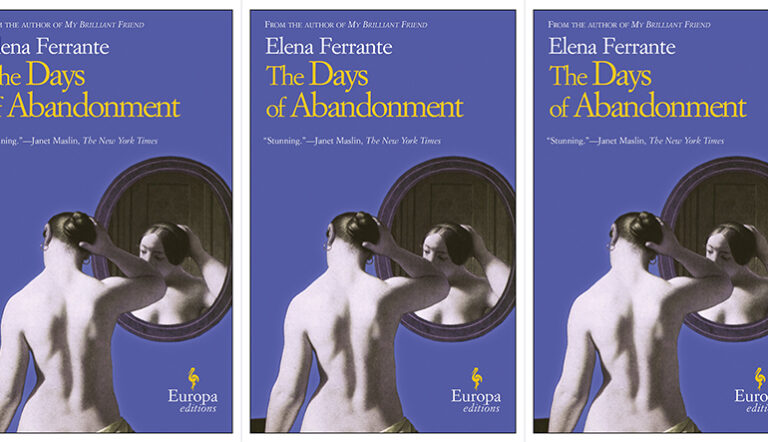
How a mysterious Italian writer’s 2002 masterpiece became the most precise map of female psychological breakdown in contemporary literature, decoded through stylometric analysis, cinematic parallels, and one reader’s journey from Sylhet to Turin.
You don’t always remember clearly where and when your path crossed with a book that would later rearrange your understanding of human catastrophe, but the moment I discovered Elena Ferrante through a YouTube video 7 years ago is still vivid in my mind. I was scrolling through The Bookchemist‘s YouTube channel, procrastinating on my work, when he spoke about My Brilliant Friend.
7 years passed before I finally opened an Elena Ferrante novel. 7 years of hearing Ferrante’s name whispered in literary circles like an incantation, of watching her HBO adaptations gather critical acclaim, of seeing her novels on “Best of the Century” lists while I remained mysteriously resistant.
We live surrounded by more books than any generation in history, yet we spend our time watching videos about books we promise ourselves we’ll read tomorrow. There’s something beautifully absurd about this condition of infinite literary procrastination.
But perhaps this is how the most important encounters happen. Not when we seek them, but when invisible hands arrange the meeting at precisely the moment we need it most.
Reading in the Margins
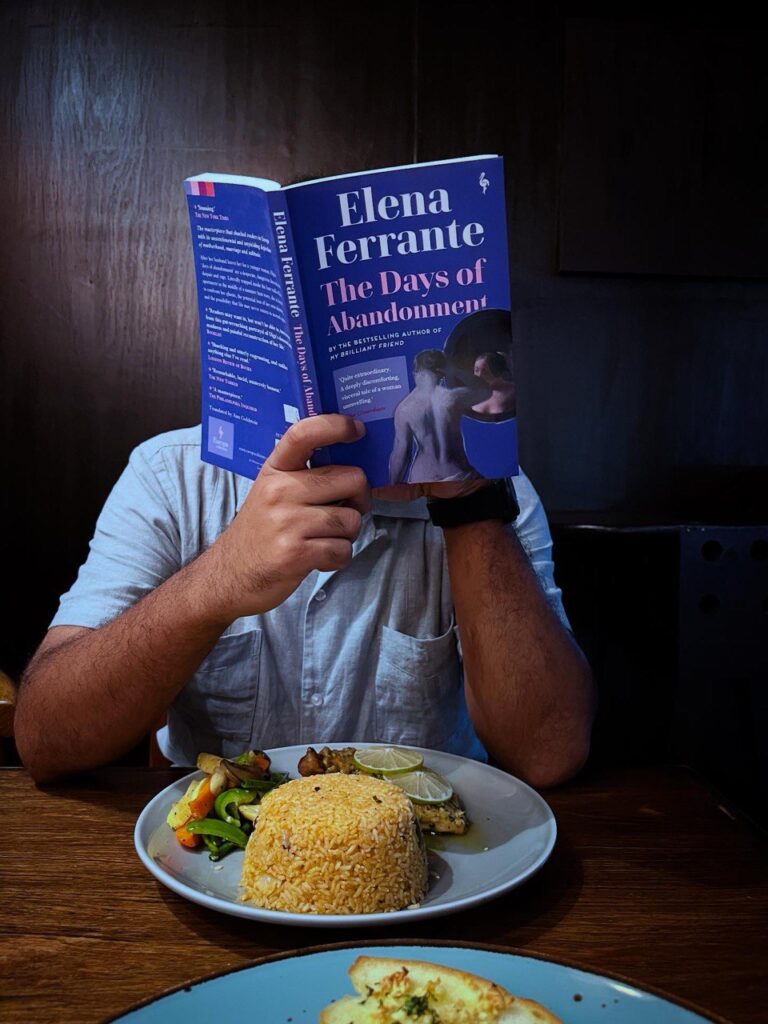
The Days of Abandonment found me during August 2025, my 3rd book of the month, when I was juggling probably 12 different titles. The curse of a passionate reader, really. We are literary polygamists by nature, incapable of fidelity to a single story. Working my 9-to-6 job at a software firm in Bangladesh, while trying to carve out reading time in spaces between huge responsibilities, I discovered this book demanded to be read in stolen moments, and weekends, of course.
During office breaks, hunched over my desk while colleagues discussed quarterly reports, I contemplated the mechanics of marital collapse. In quiet corners of SUST campus near the water bodies, I’d escape with only lotus and birds, a few mosquitoes, and turning pages for company. Late at night before sleep, Ferrante’s prose pulled me into Olga’s maddening world with a gravitational force that made my carefully constructed life feel suddenly fragile. I was petrified at times, thinking about the horrors of human misery.
On a few evenings, I tried to bring the book to dinner with my partner. Between courses, we discussed how Ferrante manages to excavate a woman’s psyche with archaeological precision. This is Ferrante’s peculiar gift. The author doesn’t just write about women’s experiences. Also, performs emotional surgery on them and exposes nerves that most of us prefer to keep safely buried.
Reading Ferrante’s female voices as a male feels like accidentally overhearing a conversation you weren’t meant to hear, but desperately needed to. It connects to what I’ve read about films exploring women’s psychology. From Akerman’s Jeanne Dielman, 23 quai du Commerce, 1080 Bruxelles to Michael Haneke’s The Piano Teacher, cinema has long been fascinated by the spectacle of feminine madness. But where films often observe from outside (especially without the narrations), Ferrante writes from inside the collapse itself.
The Perfect Opening
Ferrante’s opening line still delivers its payload: “One April afternoon, right after lunch, my husband announced that he wanted to leave me.” She sets the scene with devastating economy. Routine domestic tableau suddenly shattered by news delivered with casual brutality.
This sentence contains everything necessary to understand what follows: ordinary life, extraordinary rupture, the terrible casualness of life-altering announcements. The juxtaposition of mundane timing (“right after lunch”) with catastrophic content (“wanted to leave me”) creates immediate emotional whiplash that mirrors Olga’s psychological state throughout the novel.
The Days of Abandonment explores what happens when carefully constructed lives crumble in single afternoons. Olga, the protagonist, experiences abandonment not as passive suffering but as active destruction of self. She becomes simultaneously archaeologist and excavation site, digging through layers of identity that 15 years of marriage and motherhood have created.
The novel’s claustrophobic atmosphere mirrors Olga’s psychological state. Much of the action unfolds in her Turin apartment during sweltering August heat. When her dog Otto falls ill, her phone dies, and her keys jam in the lock, Ferrante orchestrates a perfect storm of domestic crisis that forces Olga to confront her own resourcefulness.
There’s dark comedy embedded in this crisis. Life’s talent for turning our most serious moments into elaborate practical jokes. A woman’s marriage collapses, and suddenly she can’t even open her own door. The metaphor is so obvious it becomes sublime, as if the universe decided psychological breakdown wasn’t sufficient drama without adding physical comedy.
Deconstructing Olga’s Identity Layers
Ferrante constructs Olga’s character breakdown, revealing how identity forms in layers that can be systematically stripped away. The first layer to crumble is linguistic control. Olga, an educated woman who spent years suppressing her Neapolitan accent, begins reverting to crude expressions from childhood. She becomes “vulgar in mind and gesture, as relief from unbearable pain.”
This linguistic regression signals deeper psychological archaeology. The civilized self she constructed through education and marriage dissolves, revealing older, more primitive layers beneath. Her relationship with her body changes dramatically. Where she once maintained careful grooming expected of respectable wives, she now lets herself deteriorate. This isn’t simple neglect but rebellion against performed femininity that marriage demanded.
Most devastatingly, her maternal capacity fails. She struggles to care for her children, Gianni and Ilaria. Her maternal instincts, once automatic, require conscious effort. She cannot provide emotional support during their crisis. The children become burdens rather than sources of meaning, a failure that terrifies her more than her husband’s abandonment because it threatens her most fundamental identity.
Ferrante demonstrates how quickly competence transforms into incompetence when supporting structures shift. Olga, capable of managing complex household responsibilities with a partner, suddenly cannot operate the simplest mechanisms of daily life. The keys jamming in her lock become perfect metaphor for her broader inability to access the life she thought she knew.
Her dependency on Mario wasn’t just emotional but existential. She constructed her entire identity around being his wife. When he leaves, she doesn’t just lose a partner; she loses herself. The woman who remains is a stranger, someone she doesn’t recognize or particularly like.
Shadow Self and Social Mirror
One of the novel’s most haunting elements is Olga’s obsession with a woman she witnessed years earlier in Piazza Mazzini. This woman, abandoned by her husband, had completely lost control in public. Screaming, disheveled, she represented everything Olga feared becoming. The memory haunts Olga throughout her breakdown because it suggests her current crisis might not be temporary but permanent transformation.
This figure functions as Olga’s shadow self, showing what abandonment can do to female identity. But she represents something more complex: the possibility that breakdown might be truth-telling, a refusal to maintain normalcy’s performance when life becomes abnormal. Ferrante uses this figure to explore how women’s pain gets pathologized in public spaces.
The woman in the piazza wasn’t just suffering. She was suffering visibly, violating social expectations about how women should manage private pain. Olga’s terror of becoming this woman reveals her internalized misogyny, her belief that women who cannot contain their suffering are fundamentally flawed. Yet as her own breakdown progresses, she begins understanding that visible suffering might be more honest than invisible endurance.
This connects to broader themes about women’s socialization that appear throughout Ferrante’s work and echo in films like Todd Haynes’ Safe (which I haven’t watched but have read about in feminist film criticism) or Chantal Akerman’s Jeanne Dielman (similarly unviewed but familiar through cinema studies), where domestic routine becomes prison and women’s contained suffering eventually erupts.
The Archaeology of Adult Vulnerability
Ferrante excavates Olga’s childhood, showing how early experiences shaped adult vulnerabilities. Olga’s mother had warned her that women without men cannot survive. This message, internalized in childhood, becomes self-fulfilling prophecy in adulthood. She learned early to suppress her authentic self in favor of what would make others comfortable, to speak correctly, behave properly, want the right things.
The childhood memories surfacing during breakdown are telling. They reveal a girl who learned that conformity was survival strategy, that authentic self-expression was dangerous luxury. But underneath, a wilder self was always waiting, speaking in Neapolitan dialect, thinking thoughts that polite society wouldn’t approve.
This psychological archaeology connects Ferrante to other writers exploring how women’s socialization creates later vulnerabilities. From Virginia Woolf’s Mrs. Dalloway to Sylvia Plath’s The Bell Jar, literature has long documented how the price of feminine conformity is often fundamental alienation from authentic self. What makes Ferrante distinctive is her refusal to romanticize this process.
Physical Crisis as Psychological Breakthrough
The novel’s climax occurs during a sweltering August day when multiple crises converge with hallucinatory intensity. Olga’s son Gianni develops fever while their dog Otto shows poisoning symptoms. Her phone line dies. Her keys jam in the lock. She finds herself trapped in her apartment, unable to call for help, responsible for sick dependents while having her own psychological crisis.
This scene reads like fever dream itself. Reality becomes unstable. Cause and effect blur. Olga begins suspecting she might be poisoning both her son and dog, though there’s no evidence. Her paranoia reaches its peak just as her isolation becomes complete. The apartment becomes prison, the domestic space that once provided security now threatening to become tomb.
But this crisis forces breakthrough. Confronted with genuine emergency, Olga discovers resources she didn’t know she possessed. When her neighbor Aldo finally appears, she manages to open the jammed door herself. The mechanical problem that seemed insurmountable becomes solvable when she stops panicking and starts thinking clearly.
Otto dies, but Gianni recovers. The crisis passes, but something fundamental has changed. Olga has learned she can survive genuine emergency, care for her children without a husband, solve problems that once seemed impossible. The fever dream becomes initiation ritual, stripping away illusions to reveal actual capabilities.
Cinema of Feminine Madness
While reading Ferrante, I found myself thinking about films exploring similar psychological territory. I’ve seen Darren Aronofsky’s Black Swan, Michael Haneke’s The Piano Teacher, and Lars von Trier’s Antichrist, all examining women’s mental breakdown. What distinguishes Ferrante from these cinematic treatments is her refusal to make madness spectacular.
Films like Repulsion or Satoshi Kon’s Perfect Blue, often present female madness as visual spectacle. The breakdown becomes something to observe, analyze from outside. Ferrante writes from inside the experience itself. We’re not watching Olga lose her mind; we’re experiencing it with her.
This connects to broader questions about representing women’s suffering in art. Too often, it becomes aesthetic object rather than lived experience. Ferrante resists this aestheticization. Olga’s pain isn’t beautiful or transcendent. It’s messy, embarrassing, utterly ordinary in its extraordinariness.
From what I’ve read about John Cassavetes’ A Woman Under the Influence, Cassavetes shared something of Ferrante’s approach. Both insist on the significance of seemingly insignificant moments, understanding that the most profound dramas occur in the most mundane settings. Both refuse to romanticize mental breakdown, presenting it instead as complex negotiation between internal experience and external pressures.
Ferrante in the Canon of Feminine Breakdown
The Days of Abandonment exists in conversation with a long tradition of literature exploring women’s psychological collapse. From Tolstoy’s Anna Karenina to more recent works like Jenny Offill’s Dept. of Speculation, the theme of intelligent women undone by domestic arrangements runs through modern literature like recurring nightmare.
What makes Ferrante distinctive is her refusal to romanticize or pathologize Olga’s breakdown. Anna Karenina’s crisis leads to suicide under a train. Olga’s crisis leads to reconstruction and eventual independence. She doesn’t die for her troubles; she learns from them, discovering resources she didn’t know she possessed.
The novel anticipates concerns that would become central in later works exploring maternal ambivalence. I haven’t read Ferrante’s The Lost Daughter yet, but from the literary criticism I’ve encountered, it appears to continue these themes. The idea that motherhood might not be naturally fulfilling for all women, that maternal love might be more complicated than social narratives suggest.
This places Ferrante in dialogue with international contemporary writers like Han Kang, whose We Do Not Part explores similar themes of female alienation and identity reconstruction. From Mieko Kawakami’s Breasts and Eggs to Lauren Groff’s Fates and Furies, these writers refuse easy consolations about women’s suffering, insisting instead on complexity of female experience.
Ferrante Authorship Controversy & The Stylometric Inquiry
Elena Ferrante remains one of literature’s most delicious paradoxes, but recent scientific breakthroughs have brought us closer than ever to solving the mystery. For over 3 decades, she has published under this pseudonym, communicating with the world only through letters and emails, like a literary ghost who occasionally moves furniture to prove she exists.
The breakthrough came through computational linguistics. In September 2018, a team of scholars, computer scientists, philologists, and linguists at the University of Padova analyzed 150 novels written in Italian by 40 different authors, including 7 books by Elena Ferrante. This massive corpus, known as the PIC (Padova Italian Corpus), and related papers (2017-2018), represents the most comprehensive stylometric analysis ever conducted on contemporary Italian literature.
Different computer-based authorship attribution methods have been employed to answer the question “Who is behind Elena Ferrante?” The results were staggering in their consistency. Multiple independent analyses using different computational models all reached the same conclusion: Domenico Starnone, either alone or in collaboration with his translator wife Anita Raja, is the probable author behind the Ferrante corpus.
The University of Padova, under Padova University Press published a research paper based on that, titled as ‘Drawing Elena Ferrante’s Profile’.
The Starnone Connection
The stylometric evidence pointing to Domenico Starnone as Ferrante’s probable author creates fascinating interpretive possibilities. Both Ties and Days of Abandonment contain the precise detail of a glass vessel, which each wife breaks in response to her husband’s faithlessness. But this parallel raises questions rather than answering them.
If Starnone wrote both novels, we’re witnessing an extraordinary feat of gender ventriloquism. The Days of Abandonment presents such authentic feminine psychological landscape that the idea of male authorship seems almost insulting to the text’s emotional truth. Yet the computational evidence is compelling, with multiple independent analyses using different methodologies all reaching similar conclusions.
Perhaps the truth is more complex than simple authorship attribution. Starnone is married to translator Anita Raja. Could Ferrante represent collaborative identity, a literary marriage that transcends individual authorship? This would make the pseudonym not deception but deeper truth about how creative work emerges from relationships, conversations, shared lives.
The mystery has become more famous than most authors’ entire careers. It’s perfect metaphor for our age. We care more about who said something than what was actually said. Meanwhile, somewhere in Italy, a writer continues creating books that gut us emotionally while we waste time trying to figure out their real name.
Reading Ferrante from a South Asian Country
What makes The Days of Abandonment extraordinary is its ability to speak across cultural boundaries while remaining rooted in a specific Italian experience.
The universality without sacrificing specificity connects Ferrante to other international writers exploring similar themes. From Jean Rhys’s Wide Sargasso Sea to contemporary works addressing women’s psychological experience across different cultural contexts, there’s a growing international conversation about female identity that transcends geographical boundaries.
The novel’s success in translation raises questions about how emotional truth moves between languages. Ann Goldstein’s English translation captures not just Ferrante’s meaning but her psychological rhythm. The sentences still feel like thoughts thinking themselves, even in English. This suggests something universal about patterns of human psychological crisis, ways that breakdown and recovery follow similar emotional geometries regardless of cultural context.
My reading this book in a culture where women’s autonomy faces constant scrutiny, Ferrante’s unflinching portrayal of female self-reconstruction felt particularly urgent. Yet the novel’s genius lies in making the particular universal without diminishing its specificity. She doesn’t write exclusively for women but about human experiences that happen to occur in female bodies.
From Obscurity to Essential Reading
The Days of Abandonment was named one of the best 100 books of the 21st century by The New York Times in 2024, recognition that feels both overdue and entirely appropriate. This novel established the psychological intensity that would make Ferrante essential reading, paving the way for her later masterwork, the Neapolitan Novels.
The book’s influence extends beyond literature into broader cultural conversations about marriage, motherhood, and female identity. It anticipated themes that would become central to contemporary feminism: the idea that women’s suffering in domestic arrangements isn’t natural or inevitable but socially constructed, the possibility that breakdown might be a form of breakthrough.
Academic engagement has been extensive. University courses now regularly include the novel in syllabi exploring contemporary women’s literature, Italian studies, and psychological realism. Doctoral dissertations have been written analyzing its treatment of domestic space, maternal ambivalence, and linguistic identity. The novel has spawned academic conferences, critical editions, and scholarly monographs.
Its cinematic adaptations tell their own story. Roberto Faenza’s 2005 Italian film adaptation captured some of the novel’s claustrophobic intensity but couldn’t replicate its internal psychological landscape. HBO’s planned adaptation starring Natalie Portman was shelved when Portman left the project, suggesting the difficulty of translating Ferrante’s interior focus to visual medium.
Why It Matters More Than Ever
20 years after publication, The Days of Abandonment feels urgently contemporary. In our era of rising divorce rates, evolving definitions of family, and changing gender roles, Olga’s story speaks to anyone who has felt their carefully constructed reality suddenly rearrange itself into unrecognizable geometry.
The novel predates social media but eerily anticipates our current landscape of performed normalcy and private dissolution. Reading it during lunch breaks from corporate life, I was struck by Ferrante’s understanding of how quickly competent adults can feel utterly incompetent when supporting structures shift.
There’s something both tragic and comic about this condition. We spend years building lives that can be dismantled by single conversations over lunch. The fragility of our domestic arrangements becomes visible only when they begin to crack. We are all just one casual announcement away from discovering we don’t actually know how to operate the most basic mechanisms of our own existence.
This connects to broader anxieties about modern life that appear in writers like Ottessa Moshfegh’s My Year of Rest and Relaxation or films examining how contemporary existence itself might be making us sick. The sense that our carefully constructed lives might be more fragile than we want to admit.
Europa Editions: The 20-Year Cultural Revolution
My copy bears the Europa Editions imprint, and understanding their role is crucial to appreciating The Days of Abandonment‘s impact.
Founded in 2005, Europa Editions published the first English translation of this novel in the same year, when Ferrante was still relatively unknown outside Italy.
I feel like this year’s Europa’s 20th anniversary celebration represents more than just a corporate milestone. It marks 2 decades of consistently championing international voices that refuse to behave politely at dinner parties.
Their commitment to Ferrante proved prophetic. What began as a modest publication became a cultural phenomenon. Ferrante’s works (esp. the Neapolitan Quartet) have sold 14–16M+ copies, spawning HBO adaptations (the My Brilliant Friend series), academic conferences, and endless literary analysis.
Europa’s catalogue has shaped contemporary reading in ways both visible and subtle. From Ferrante’s Neapolitan Novels to Muriel Barbery’s The Elegance of the Hedgehog, Jane Gardam’s Old Filth, Damon Galgut’s Booker-winning The Promise, and newer voices like Mieko Kawakami and Alina Bronsky, their list reads like a map of global literary currents.
To mark their twentieth year, Europa is releasing redesigned anniversary editions of twenty landmark titles. Many include new interviews, guides, and other material, bringing back both perennial favorites and once-brilliant books that risked being drowned in the noise of publishing.
As a reader, I can only wish Europa Editions many more decades of discovering writers who unsettle us, disturb us, and in the process, remind us why literature matters at all.
The Unbearable Lightness of Literary Immortality
Some books entertain us briefly then fade like pleasant dreams. The essential ones refuse to leave. They teach us survival strategies for when keys jam at worst possible moments, when people we thought we needed most reveal themselves to be beautifully, devastatingly replaceable.
The Days of Abandonment belongs to this second category. A masterclass in psychological realism that changes readers through accumulated truth rather than dramatic revelation. It’s a novel about learning to open doors when mechanisms fail, about discovering inner resources we didn’t know we possessed.
As I sit here in Sylhet, my Europa Editions copy beside me, I’m grateful for this 20-year-old gift that feels as fresh as tomorrow’s crisis. The book has that rare quality of feeling both ancient and immediate, as if it were written yesterday about something that happened centuries ago.
Somewhere in Italy, a mysterious writer keeps creating these precise instruments for understanding what we can and cannot survive. Whether that writer is Elena Ferrante, Domenico Starnone, Anita Raja, or some collaborative identity that transcends individual authorship, the work itself remains undiminished by questions of attribution.
The best abandonment, it turns out, is abandoning our illusions about what we can endure. Sometimes the most important books are the ones that teach us this lesson while we’re sitting by water bodies reading between the lines of our own carefully constructed lives, learning that survival is not about avoiding breakdown but about discovering what remains when everything else falls away.
20 years later, Europa Editions’ gift to English readers continues giving. In a world of literary noise, they consistently publish the signal: books that matter, that endure, that change how we see ourselves and others. The Days of Abandonment stands as testament to literature’s highest calling: not to comfort us with lies but to equip us with truths we need to survive the inevitable crises of being human.
What books have taught you about survival? Have you encountered literature that refuses to let you abandon yourself? Share your encounters with books that excavate the buried truths of human experience.
